A modern royal family by A. J. Dalton
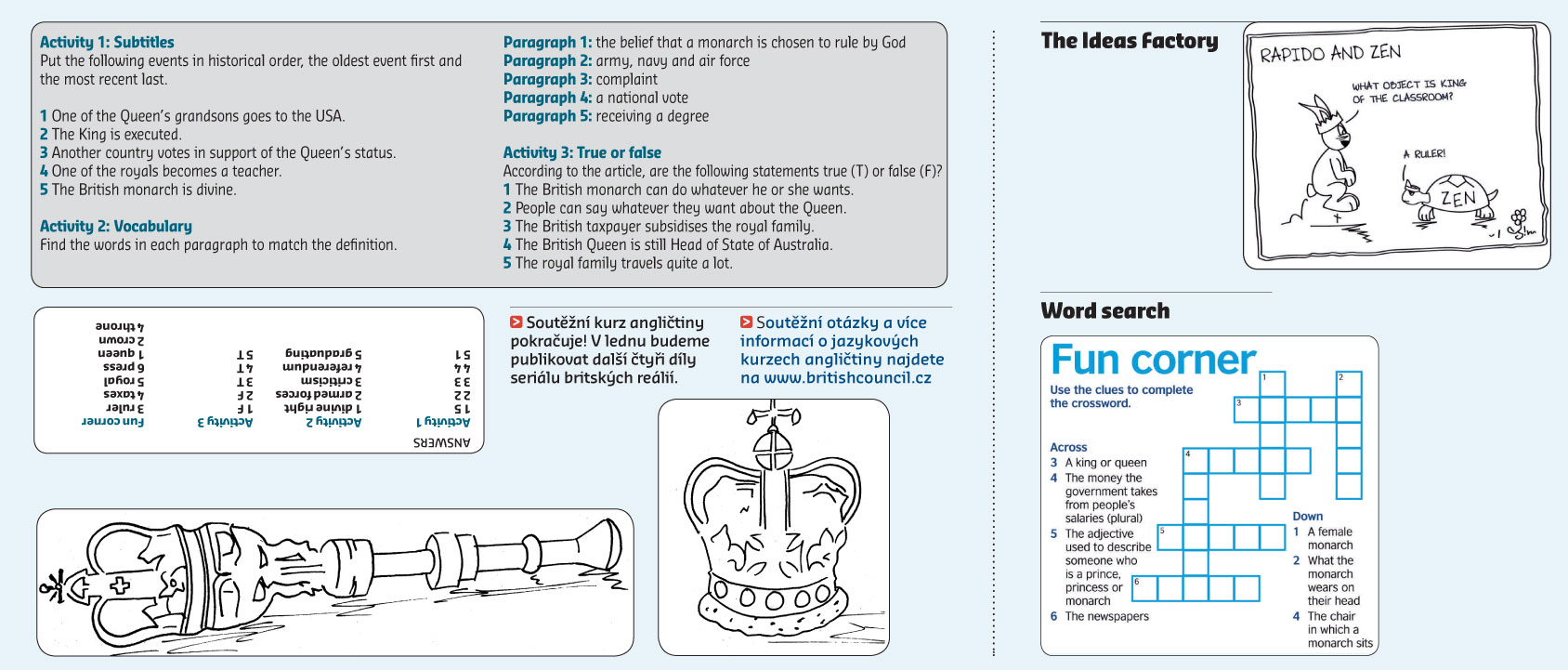
1 In certain countries of the world, the king or queen is still considered to be a demi-god. The UK is not one of those countries. It's true that up until the 17th century, the British king or queen was believed to rule by 'divine right', which was the idea that God chose the king or queen to rule and that he or she was therefore above the law. The idea that the monarch was above the law ended with the English Civil War, in which King Charles the First was imprisoned and then beheaded in 1649.
2 So what does the British royal family represent for the British people today? Well, a large number of things. The royal family are of course a part of British history and British cultural identity. It just wouldn't feel the same if there were no royal family (and tourism would certainly be affected). In addition to that, however, the Queen has important formal duties:
as Head of State, the Queen represents the UK on visits abroad and invites other world leaders to visit the UK
as Head of the Armed Forces, only the Queen can declare when the UK is at war or when war is over
as Head of the Church of England
as a political entity, the Queen has to read and sign government and Commonwealth documents every day.
3 When it comes to politics, the Queen today represents a neutral voice that puts the concerns of the country before the interests of any individual political party. Her Majesty therefore represents the country at particular times of celebration and sadness as well. Finally, the Windsor royal family spend a great deal of their time travelling up and down the country in support of different charities and regional projects.
Despite the work the royal family does for the UK, there are British people called 'anti-monarchists' who do not believe there should be a royal family. Sometimes, the press and media criticise the royal family as well, since the UK is a democracy and freedom of speech is allowed as long as it does not encourage violence. One criticism is that the British people should not have to pay for the royal family through their taxes, particularly during a credit crunch. Another is that Buckingham Palace should be open to the public more often, in order to pay for the building repairs that are necessary.
4 There are critics outside of the UK as well. In 1999, the Australian government called a referendum to decide whether the country should become a republic with a president, rather than having the British Queen as the Australian Head of State. In the end, Australia voted for the British Queen.
5 What the information above shows is that the British monarchy still has an important function and meaning for many people today. It is not just about tradition. The Windsor royal family also works hard to be relevant in the modern world. The Queen's Speech on television is less formal every Christmas, and is now available as a podcast. In 2005, after graduating from university, Prince William spent time teaching English in Uruguay, the sort of work many young British people do at some time in their lives. In 2009, Prince Harry visited New York to help a number of charities. Many people would agree that the British royal family is as popular as it's ever been.
 Přidejte si Hospodářské noviny
mezi své oblíbené tituly
na Google zprávách.
Přidejte si Hospodářské noviny
mezi své oblíbené tituly
na Google zprávách.
Tento článek máteje zdarma. Když si předplatíte HN, budete moci číst všechny naše články nejen na vašem aktuálním připojení. Vaše předplatné brzy skončí. Předplaťte si HN a můžete i nadále číst všechny naše články. Nyní první 2 měsíce jen za 40 Kč.
- Veškerý obsah HN.cz
- Možnost kdykoliv zrušit
- Odemykejte obsah pro přátele
- Ukládejte si články na později
- Všechny články v audioverzi + playlist