To work like a dog by A. J. Dalton
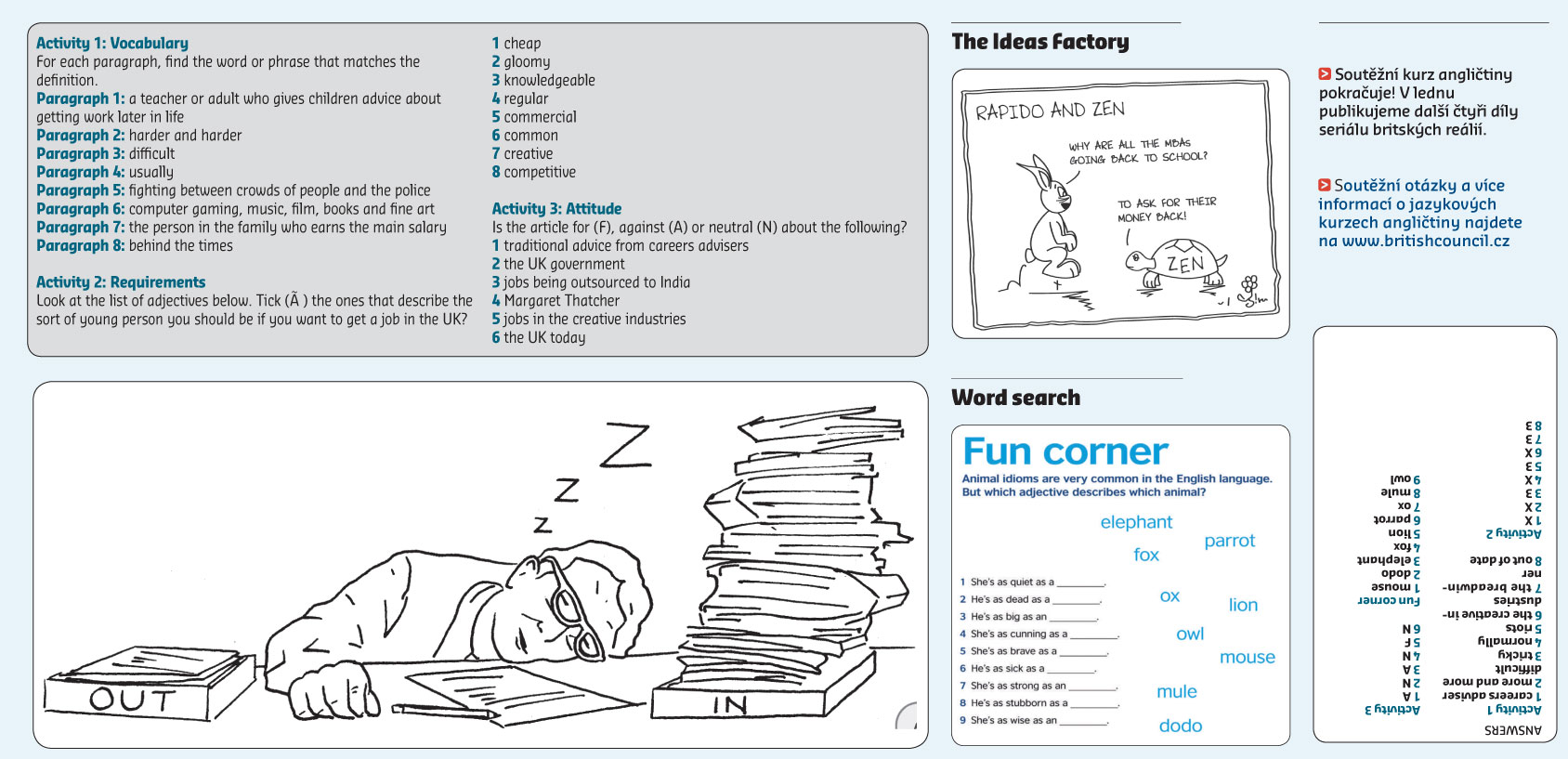
1 When you were at secondary school, was there a careers adviser? Did he or she tell you that if you worked hard you could do any job you wanted once you left school or university? That's what happens a lot in the UK, but many young people in Britain today are finding the reality of working life very different to the promise the careers adviser gave them.
2 The first thing to say is that it's becoming more and more difficult for young people to find a regular job in the UK. Since the credit crunch there has been a rise in unemployment to 7.2 per cent, which is the highest rate since 1996. Things are even worse for new university graduates, for whom unemployment rates are at 17 per cent. Even if young people decide to apply for lower-paid jobs, they find that there is a lot of competition from workers who have travelled from other countries in the European Union (for example, Poland) to work in the UK.
3 If a young British person does manage to find a job, they then find it is harder than they might have expected. On average, British workers work more hours a week than workers in any other country in Europe. Surely the UK government should do something to improve things for British workers, shouldn't it? Well, it's tricky. If British workers were to start working fewer hours, the UK economy would be damaged and would become less competitive than the economies of other countries. Then, there would be even fewer jobs available in the UK.
4 And the UK economy is struggling to remain competitive with largescale economies such as India and China. Because workers are relatively cheap in India, a lot of big UK companies have outsourced their call centre jobs to that country. A British person who wants to talk to their British bank these days normally has to telephone and talk to someone in Delhi. You can imagine how many British people feel about that!
5 When it comes to manufacturing goods, the UK cannot compete with a country that can create larger volumes of goods for less money, for example China. It was because of this sort of situation that the British Prime Minister Margaret Thatcher, back in the 1980s, decided that the UK should become a 'service sector' country rather than a 'manufacturingbased' country. Margaret Thatcher closed many UK coal mines, causing riots up and down the country, and started to give government money to individuals who wanted to set up their own small businesses.
6 So if the UK doesn't have as many low-paid jobs as before, and doesn't have as much manufacturing, what does it have? Well, it has more jobs in 'advanced technology', research, consultancy, international education and the 'creative industries'. The creative industries include areas such as computer gaming - with UK titles Lara Croft, Fable, Black and White, and Grand Theft Auto, for example. And music - UK pop stars and bands are a global business. And books, films and fine art. This sort of economy is often called a 'knowledge economy', an economy that manages to turn its culture into a set of commercial products.
7 So it's not all doom and gloom. The types of jobs available for young people in the UK are often creative and dynamic, and encourage selfexpression. The jobs are not just financially rewarding, they are often emotionally rewarding as well. They are the sort of jobs that can be done from home. They are equally accessible to men and women. It's increasingly common for the woman in a UK family to be the breadwinner, while the man is the househusband who looks after the young children. In the last year, there has been an 80 per cent increase in the number of househusbands.
8 I tell you what, it's a very different UK to the one I grew up in. It's a bit scary sometimes, because I often feel out of date. Still, I published my first novel last year, and that was probably possible only because of the strength of the UK's knowledge economy.
 Přidejte si Hospodářské noviny
mezi své oblíbené tituly
na Google zprávách.
Přidejte si Hospodářské noviny
mezi své oblíbené tituly
na Google zprávách.
Tento článek máteje zdarma. Když si předplatíte HN, budete moci číst všechny naše články nejen na vašem aktuálním připojení. Vaše předplatné brzy skončí. Předplaťte si HN a můžete i nadále číst všechny naše články. Nyní první 2 měsíce jen za 40 Kč.
- Veškerý obsah HN.cz
- Možnost kdykoliv zrušit
- Odemykejte obsah pro přátele
- Ukládejte si články na později
- Všechny články v audioverzi + playlist