What's a university education worth? An article by A. J. Dalton
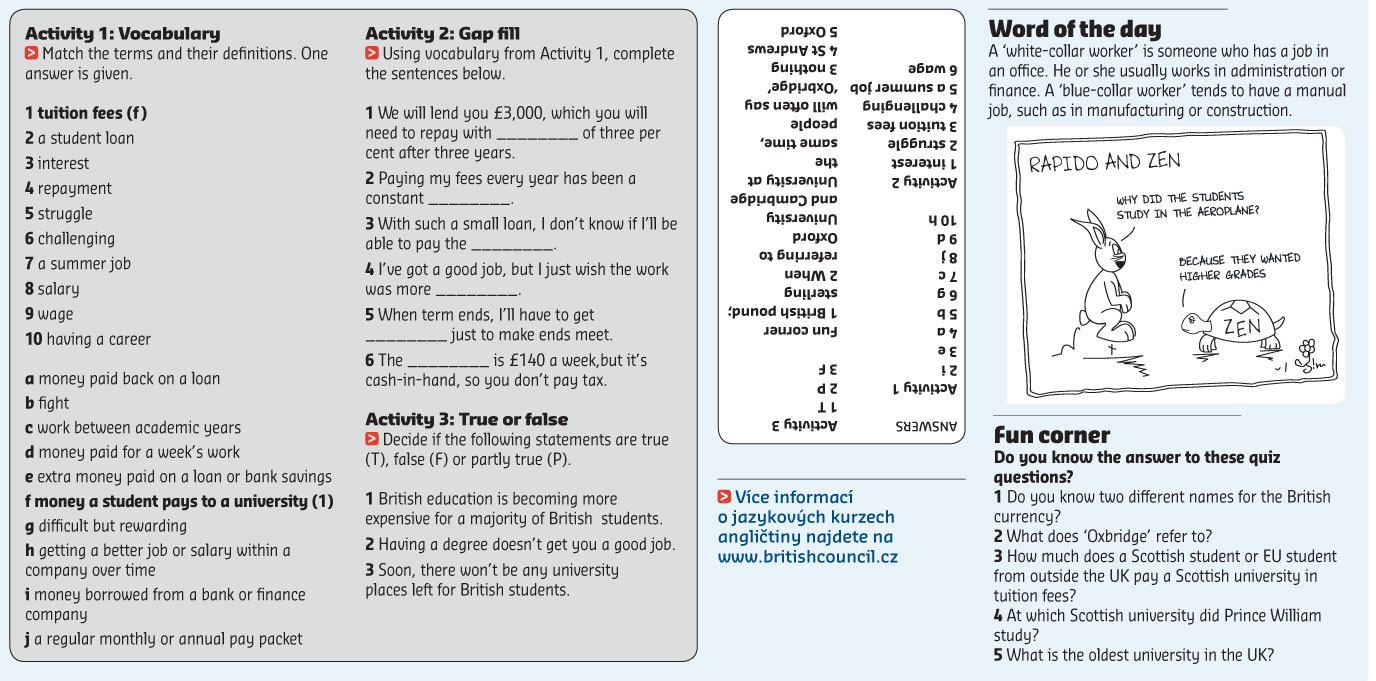
In 2006, the UK government started to allow universities in England and Wales to charge British students tuition fees. As a result, more than 80 per cent of students in England and Wales now take out a student loan in order to go to university. They use the loan to pay for tuition fees, books and living expenses. Although the interest on student loans is quite low, it begins as soon as the student receives the loan.
The average student in England and Wales now graduates from university with debts of around #194#Ł12,000. Students of medicine, who study for longer, usually have debts of more than #194#Ł20,000. That is a lot of money. It means graduates cannot afford to buy a house for many years. They even struggle to pay rent on a flat, because they have to start paying back the student loan when they reach the April after graduating (or after leaving a course). If you start to earn over #194#Ł15,000 a year, the government takes repayments directly from your monthly salary. Is it any surprise, therefore, that the average British person does not leave their parents' home until they are 30 years old?
You might think that a British person with a degree will find it easy to get a well-paid job. However, most people in 'whitecollar jobs' seem to have a degree these days, so there is a lot of competition. Also, British companies tend to value work experience over a piece of paper. Like everyone else, graduates usually have to start at the bottom and work their way up. That can be very frustrating for them, since they are often over-qualified for the work they are doing. While at university, they had dreams of getting an exciting, challenging job. Therefore, life after university ends up being quite disappointing for a lot of graduates.
All of the above is beginning to make British people question whether a university degree is really worth the money. Even before the credit crunch started, the BBC stated: 'The number of British students at UK universities has fallen for the first time in recent history, from 1.97 million in 2007 to 1.96 million last year [2008].' It looks like the figures will continue to decline, since loan companies are now telling some students that there are no loans available for them. Forecasts are that between 2009-19 there will be fall of six per cent in the number of 18- to 25-yearold university applicants across the UK.
Students have always been thought of as not having a lot of money, but 'student poverty' is now considered a real problem in the UK. Most British students expect to have to get a loan, part-time job or summer job. Worse than that, however, is the fact student leaders report there are increasing numbers of students turning to crime to support themselves financially.
By contrast, things are now easier for students from other countries coming to study in the UK, since the value of the British pound has fallen. More international students come to Britain each year. The British universities offer more and more of the available places to richer international students rather than poorer British students. Some British people fear that, one day, there won't be any university places left for British students at all.
Více informací o jazykových kurzech angličtiny najdete na www.britishcouncil.cz
 anket
anket
 Přidejte si Hospodářské noviny
mezi své oblíbené tituly
na Google zprávách.
Přidejte si Hospodářské noviny
mezi své oblíbené tituly
na Google zprávách.
Tento článek máteje zdarma. Když si předplatíte HN, budete moci číst všechny naše články nejen na vašem aktuálním připojení. Vaše předplatné brzy skončí. Předplaťte si HN a můžete i nadále číst všechny naše články. Nyní první 2 měsíce jen za 40 Kč.
- Veškerý obsah HN.cz
- Možnost kdykoliv zrušit
- Odemykejte obsah pro přátele
- Ukládejte si články na později
- Všechny články v audioverzi + playlist